0
No products in the cart.


Published by : TarantulaShop™ (tarantulashop.co.za)
Principal Investigator : Private Collection Specimen Research Initiative
Date : September 2026
ABSTRACT
This monograph formalizes a highly specialized, experience-based husbandry system engineered
specifically for the miniaturized arboreal trapdoor genus Typhochlaena over a continuous two-year study
period. By discarding conventional high-humidity stagnation paradigms in favor of active dual-zone
convective airflow and boundary-layer gas exchange optimization utilizing Soil X™, this research
documents significant decreases in captive mortality. Detailed behavioral findings regarding ontogenetic
prey configurations, defensive motor habits, and successful reproductive cycles (yielding natural hatching
emergence within a 50-day timeline) are structurally delineated to replace generic keeping literature with
verifiable empirical framework metrics.
DOCUMENT INDEX
1. Introduction: My Journey with the Genus
2. Enclosure & Microhabitat Design: Redefining Airflow and Substrate
2.1 The Structural Foundation: Utilizing Natural Contours
2.2 The Science of the Substrate: Soil X™ and Gas Exchange
2.3 Material Supplements: Accelerating Construction
3. Environmental Management: Temperature & Seasonal Cycles
3.1 The Hydration Cycle: Adapting to the Seasons
4. The Feeding Strategy: Precision Protocols
4.1 Prey Preferences by Growth Stage
4.2 Sling Protocol: The Overnight Lab Vial Method
4.3 Adult Feeding Protocol
5. Behavioral Insights: Myth-Busting and Cryptic Habits
5.1 The ‘No-Trapdoor’ Phenomenon
5.2 Ground Dwelling: De-stigmatizing Terrestrial Behavior
6. Troubleshooting Problematic Feeders: Advanced Tease-Feeding Mechanics
6.1 The Tweezers & Tease-Feeding Method
6.2 Reading Their Defenses: The Front-Leg ‘Kick’
6.3 The ‘Front-Leg Drop’ Technique (Advanced)
7. Breeding & Reproduction: The Reward of Seasonal Shifts
7.1 Receptivity & Courtship
7.2 Post-Pairing Management & Incubation
1. Introduction: My Journey with the Genus
When I first entered the world of Typhochlaena, I was captivated by more than just their striking, jewel like appearance. I was drawn to the unique husbandry challenge they present. Over the past two years, my fascination has evolved into a true passion, driving me to specialize in this incredible genus. Through dedication and meticulous observation, I have been fortunate enough to successfully breed them a handful of times, an achievement that completely shifted my understanding of their lifecycle and needs. This guide is not a generic, copy-and-paste care sheet filled with recycled internet statistics or mechanical humidity percentages. Instead, it is a transparent log of my real-world findings, practical trials, and hard earned successes. My goal in sharing these personal insights is to look past the widespread myths of the hobby and provide you with a reliable, hands-on framework based entirely on what actually happens on the shelves of my facility under the authority of TarantulaShop™.
2. Enclosure & Microhabitat Design: Redefining Airflow and Substrate
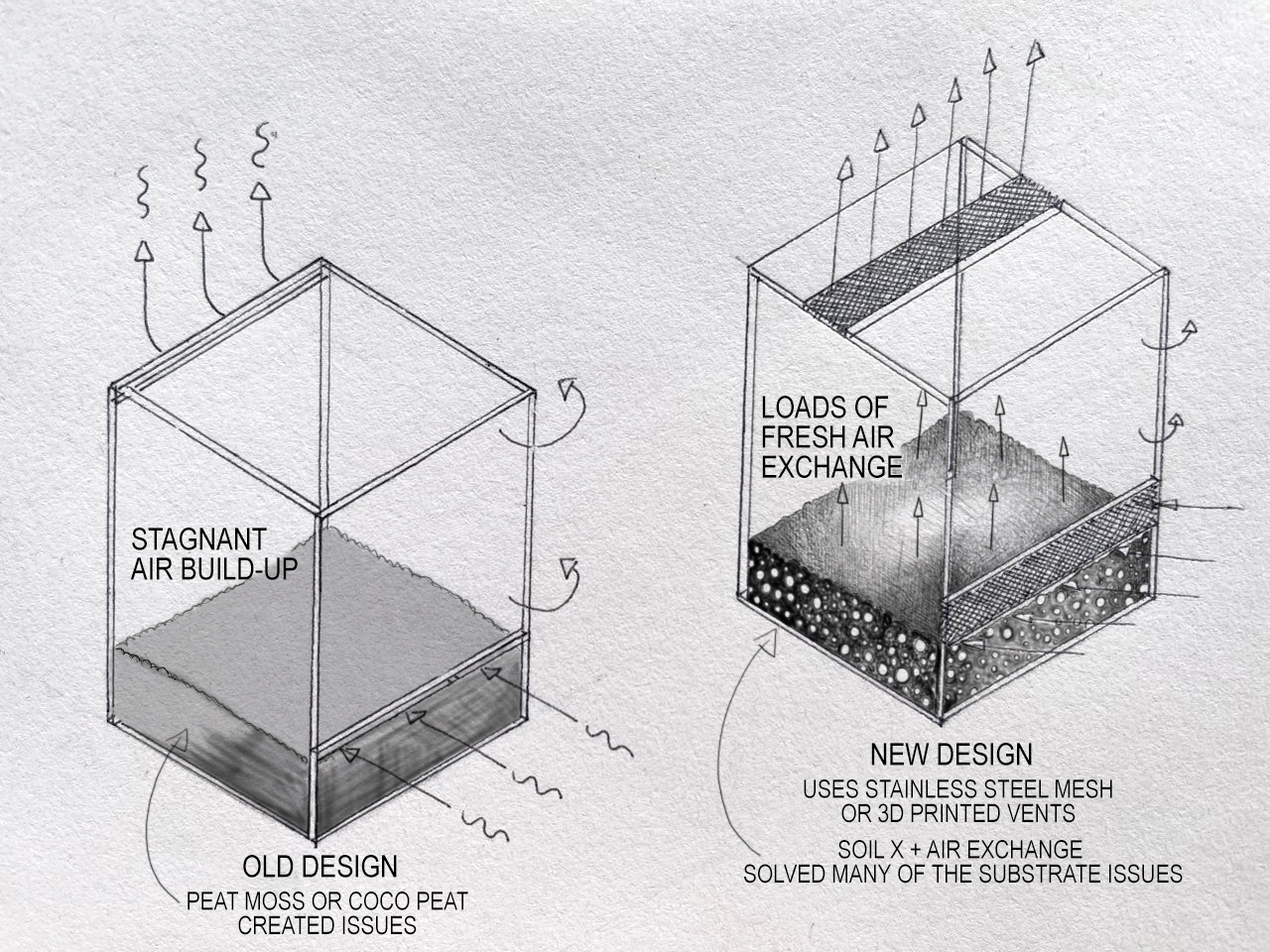
My approach to housing Typhochlaena has undergone a profound evolution. Early in my journey, I fell into a common hobby trap: I utilized enclosures with highly limited ventilation, operating under the assumption that sealing the environment was the only effective way to lock in vital moisture. Experience quickly corrected this misconception. I learned that restricted airflow does not create a healthy, humid microclimate; instead, it traps stagnant, low-quality air—creating a breeding ground for pathogens that causes far more harm than good to these delicate dwarf arboreals.
To truly understand and succeed with this genus, you must look past the plastic walls of the enclosure and understand the soil. You have to grasp the biological ecosystem of the substrate and what it produces. Armed with this realization, I completely overhauled my husbandry strategy. I transitioned my spiders to highly ventilated swing-door enclosures featuring both front and top ventilation zones. This dual zone airflow creates a natural, gentle convective current that keeps the air pristine while preventing stagnant pockets.
2.1 The Structural Foundation: Utilizing Natural Contours
One of the most critical breakthroughs in my husbandry involved identifying the exact physical contours. Typhochlaena require to build their homes. Standard, flat cork pieces often fail to trigger their architectural instincts. Through trial and error, I found that a piece of wood featuring a distinct ‘V’ shape and a thin layer of stripable bark is highly necessary. To consistently achieve this in my enclosures, I use the natural branches sold as parrot perches. These branches provide the perfect physical geometry. The ‘V’ split gives the spider a secure, natural crevice to anchor the sides of their retreat, while the thin, stripable bark provides the exact raw material they need to flake off and weave into the silk of their trapdoor for flawless camouflage.
2.2 The Science of the Substrate: Soil X™ and Gas Exchange
The foundation of my customized environment relies entirely on Soil X™ by Tarantulashop. Rather than assembling a loose mix of standard hobby materials, I chose this specific substrate because its proprietary blend of premium, natural ingredients works actively to support a highly specialized, self sustaining ecosystem. What sets this substrate apart in Typhochlaena husbandry is how it directly interacts with the enclosure’s airflow. Soil X™ is uniquely structured to facilitate and enhance internal air exchange rates. In a high ventilation setup, standard soils can either desiccate instantly or compact into anaerobic mud. Soil X™, however, maintains its structural integrity. It allows oxygen to penetrate deep into the lower layers while assisting the front and top ventilation grids in cycling out heavy gases. As a direct result of combining this substrate with dual-zone ventilation, the atmosphere inside my enclosures maintains exceptionally low carbon dioxide (CO2) levels. This is a critical factor that many standard care sheets overlook. In the wild, these spiders live on open tree trunks exposed to constant atmospheric movement. By ensuring that carbon dioxide (CO2) cannot pool or stagnate at the substrate level, I have drastically improved sling survival rates and overall colony vigor.
2.3 Material Supplements: Accelerating Construction
While the stripable bark on the parrot perches provides the core building block for their homes, you can subtly encourage their architectural instincts by mimicking natural forest debris: placing small bits of loose, organic materials on the substrate floor can sometimes help accelerate trapdoor construction. Scattering tiny fragments of dried moss, fine lichen, or minuscule bits of bark gives the spider easy, pre-fractured pieces to harvest. However, it is important to note that this is not a given. Even with a floor rich in building materials, some individuals will still choose to wait months before spinning their first door. It is simply an extra tool to prompt them, not an absolute guarantee.
3. Environmental Management: Temperature & Seasonal Cycles
Climate control within my facility balances baseline physiological needs with strict environmental drops. I maintain my Typhochlaena collection at a constant baseline temperature of 27°C. While they thrive at this steady mark, my empirical tracking confirms that an atmospheric nighttime temperature drop of 2°C is highly beneficial to their long-term metabolic vigor, though it is not strictly necessary for standard automated maintenance.
3.1 The Hydration Cycle: Adapting to the Seasons
Maintaining the ideal moisture balance in a high-ventilation, low carbon dioxide (CO2) environment requires a dynamic approach rather than rigid daily misting. Under normal conditions, I mist the enclosure once or twice a week. This provides a brief spike in ambient moisture and allows the spiders to drink, but the dual-zone ventilation ensures the surfaces dry out efficiently between cycles.
During pairing windows, I deliberately trigger a two-month dry back period. During these two months, I scale back intervention significantly, providing only a light misting fortnightly (once every two weeks). This seasonal drying mimics natural wild cycles, which I have found to be a vital environmental cue for successful reproductive behavior
Table 1.0: Husbandry Parameter Matrix
| Environmental Factor | Conventional Hobby Advice | Proven Husbandry Method |
| Thermal Baseline | Maintain high localized heat setups or rely on unregulated heat mats. |
Maintain constant facility baseline of 27°C. An atmospheric nighttime temperature drop of 2°C is highly beneficial. |
| Hydration / Moisture | Saturate substrate layers completely; maintain damp, swampy parameters. |
Standard misting 1-2 times weekly. Transition to a 2-month dry back period (misting fortnightly) for pairing conditioning. |
| Ventilation Dynamic | Limit cross-airflow to trap heat or drill excessive, uncalibrated holes. |
Dual-zone swing-door ventilation (front/top). Direct alignment scrubs out stagnant carbon dioxide (CO2) pools. |
4. The Feeding Strategy: Precision Protocols
Because Typhochlaena are cryptic ambush predators that rely entirely on prey passing by their camouflaged trapdoors, traditional ‘drop-and-hope’ feeding methods often lead to starved slings or
uneaten, dangerous live prey wandering the enclosure. My feeding protocols are highly controlled and segmented by ontogenetic stages.
4.1 Prey Preferences by Growth Stage
Through extensive feeding trials, I have discovered that Typhochlaena display distinct preferences in prey types as they mature, likely tied to the hunting triggers of different size classes:
• Slings to Small Juveniles: I find that Red Runner roach nymphs (Blatta lateralis) work best. They are highly active, do not play dead, and are the perfect size for smaller spiders to tackle or scavenge.
• Large Juveniles to Adults: As the spiders grow, their preference shifts dramatically. They feed much better on crickets. Crickets provide a louder, heavier vibration signature on the bark, which reliably
triggers the ambush response in larger juveniles and adults compared to roaches.
4.2 Sling Protocol: The Overnight Lab Vial Method
For young slings, I pioneered a highly successful, controlled feeding method to ensure 100% strike rates and zero prey-related injuries:
1. Extraction: I carefully remove the sling from its main enclosure.
2. The Feeding Chamber: I place the sling into a sterile laboratory vial containing a small, prekilled nymph feeder.
3. The Micro-Ambush: Left overnight in this confined, sterile space, the sling easily locates and scavenges on the prekilled prey without the risk of a live feeder fighting back or getting lost.
4. Return: The next morning, I return the sling safely back to its established enclosure. This completely eliminates the frustration of trying to feed a tiny sling inside a complex arboreal setup.
4.3 Adult Feeding Protocol. Adults have a hearty appetite, especially when conditioning females for breeding. I utilize a dual approach of live and prekilled prey to ensure they are fully nourished. I feed two medium-sized live feeders per week to trigger natural ambush instincts directly from the trapdoor. In addition, I place one large, prekilled feeder directly on the upper sections of the cork bark or tree stump. Adults readily scavenge on these larger meals at night, maximizing nutrient intake safely.
5. Behavioral Insights: Myth-Busting and Cryptic Habits
Because Typhochlaena are famous for being master architects, keepers often panic when their spiders do not immediately conform to expected behaviors. My two years of intense specialization have revealed two major behavioral realities that completely contradict standard hobby anxieties.
5.1 The ‘No-Trapdoor’ Phenomenon
A common misconception is that a Typhochlaena without a trapdoor is stressed, failing to thrive, or on the brink of death. My observations prove otherwise. I have found that a large number of Typhochlaena simply do not build trapdoors for many months at a time. While providing the V-shaped parrot perches gives them the ideal opportunity, some individuals choose to delay construction. Crucially, this lack of an architectural home does not stop them from feeding and thriving. They will happily eat, grow, and navigate the enclosure completely out in the open or utilizing basic silk webbing without any decline in health. If your spider hasn’t built a door after several months, do not intervene or disturb them it is completely normal variation within the genus.
5.2 Ground Dwelling: De-stigmatizing Terrestrial Behavior
In the wider tarantula hobby, seeing a strict arboreal dwarf species sitting on the substrate is almost always treated as an emergency signal—usually blamed on bad air quality, incorrect moisture levels, or predatory mites. However, within my high-ventilation, low carbon dioxide (CO2) setups, I have routinely observed healthy individuals dwelling on the ground of their enclosures. Historically, I also assumed this terrestrial behavior was a bad sign. But through tracking these specific ground-dwelling individuals, I watched them eat, grow, and molt perfectly fine right at the substrate level. Thanks to the pristine air quality and biological stability provided by Soil X™, the ground zone is completely safe for them. If your husbandry parameters match the high-airflow design detailed in this guide, seeing a spider on the dirt is simply a natural behavioral choice, not a crisis.
6. Troubleshooting Problematic Feeders: Advanced
Tease-Feeding Mechanics. Not every Typhochlaena will hunt with textbook efficiency. You will inevitably encounter stubborn or problematic feeders that refuse to strike at prey dropped near their retreat. Over time, I have developed a specialized tactile feeding protocol that bypasses their hesitation and triggers their feeding response manually.
6.1 The Tweezers & Tease-Feeding Method
For individuals that do not readily take to food, I utilize a targeted tease-feeding technique. By gently vibrating or presenting the prey item directly at the entrance of their retreat or near their front legs using long feeding tweezers, I have found that around 50% of the time, they will successfully take the food right off the tweezers. This requires a steady hand and a patient cadence to mimic a naturally wandering insect rather than a threat.
6.2 Reading Their Defenses: The Front-Leg ‘Kick’
Understanding their body language is vital to avoid stressing a spider that genuinely does not want to eat (such as an individual in pre-molt). When a Typhochlaena species completely refuses food, they will aggressively kick out at it with their front legs. This is not a passive turn-away; it is a forceful, physical strike. They will literally knock the prey away with surprising power, sometimes hitting it hard enough to kick it right out of the grip of your tweezers. If you witness this explosive, defensive slapping behavior, it is a clear sign to cease feeding attempts and try again in a few days.
6.3 The ‘Front-Leg Drop’ Technique (Advanced)
If you are tease-feeding and notice the spider showing a subtle, curious interest rather than the aggressive front-leg strike—you can execute an advanced tactical drop: I have found that if they show a
small interest during teasing, dropping the prey item directly onto their front legs will often trigger an instant grab response. When the prey touches their sensory leg hairs, their ambush instincts override their hesitation, and they will immediately clamp onto the feeder. Master this technique with caution: it takes a significant amount of practice to get the timing and placement right, but it is a highly reliable way to get nutrients into stubborn juveniles and adults.
7. Breeding & Reproduction: The Reward of Seasonal Shifts
Breeding Typhochlaena has historically been viewed as an intimidating milestone in the hobby, often plagued by reports of female aggression or failed pairings. However, by aligning the pairing process with environmental triggers, I have unlocked a highly reliable breeding protocol.
7.1 Receptivity & Courtship
The two-month dry period detailed in my hydration cycle is the absolute key to reproductive success. When maintained on a fortnightly misting schedule for two months, the female’s biological triggers shift. Upon introducing a mature male into her habitat after this dry spell, I have found that females are highly receptive. Instead of the defensive or highly aggressive posturing often seen in poorly prepared arboreals, a properly conditioned female welcomes the male with minimal friction. The introduction is surprisingly smooth, with the female remaining calm while the male communicates through his rhythmic courtship drumming. This receptivity directly underscores the importance of mimicking natural seasonal shifts rather than maintaining a static, unchanging climate year-round.
7.2 Post-Pairing Management & Incubation
Once a successful pairing is confirmed, I immediately pivot my husbandry to simulate the onset of the wild rainy season: I immediately increase the intensity of feeding to heavily condition the female.
Simultaneously, I step up the hydration cycle: I mist once a week for a couple of weeks, and then shift to a heavier schedule of twice a week. This sudden rise in humidity after the two-month dry back mimics the natural transition to spring rains and prompts successful vitellogenesis and egg sac production. When it comes to the egg sac, I do not believe in pulling it early for artificial incubation. Egg sacs are left entirely with the mothers to hatch naturally within their intricate trapdoor complexes. Trusting the female’s natural maternal instincts yields incredible results, with the slings safely emerging around 50 days after egg sac production, perfectly established to continue the line under the professional standards of TarantulaShop™.