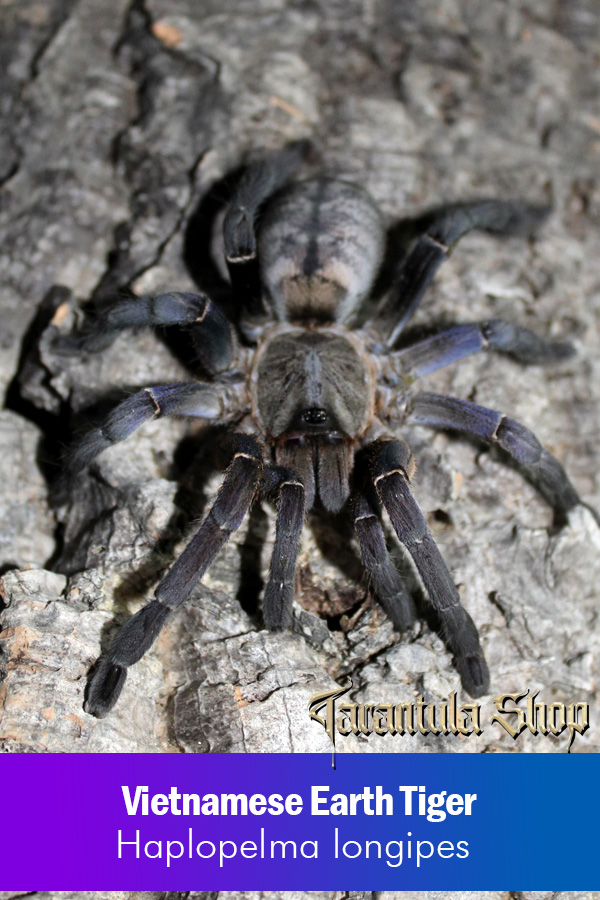
Haplopelma schmidti “Ke Bang” (now *Cyriopagopus schmidti*) is an Old World, fossorial tarantula native to southern China and Vietnam. Often referred to as the Chinese golden earth tiger, it is one of the largest Asian species, boasting a robust body with golden or dark form variations and aggressive defensive behavior.
Behavior and Temperament: A highly defensive, fast, and burrowing species. It spends most of its time hidden in a deep silk lined burrow and is known to rapidly strike when disturbed rather than adopting defensive hair-flipping
Habitat and Environment Needs: Native to steep, south facing clay slopes in tropical rainforest regions with warm temperatures (around 27 °C) and high humidity (approx. 70–80 %). In captivity, a deep, moist substrate and secure terrarium with minimal heat are essential.
Feeding: Feeds primarily on large insects. In the wild, the female has been observed providing maternal care, such as feeding pre-killed prey to her young, a rare behavior among tarantulas.
Additional Information: Females are among the largest Asian tarantulas and may live upwards of 17 years, while males are smaller and live shorter lives. The species contains a potent venom known as huwentoxin, being studied for pharmaceutical use.
| Golden Earth Tiger |
Cyriopagopus schmidti (formerly Haplopelma schmidti) |
| Category : |
Old World |
| Type : |
Fossorial (Burrower) |
| Country of Origin : |
China (Guangxi), Vietnam |
| Adult Leg Span : |
Up to 18 cm |
| Growth speed : |
Medium |
| Defense mechanism : |
Rapid strike, highly defensive venom therapy |
| Diet : |
Large insects (crickets, roaches); maternal care includes feeding pre-killed prey to spiderlings |
| Temperature : |
27 °C |
| Relative Humidity : |
70–80 % |
| Recommended Experience Level : |
Advanced |